
Förderjahr 2025 / Stipendium Call #20 / ProjektID: 7728 / Projekt: Learning in the Quantum Regime
Quantum measurements are slow, while classical processors are fast, however, so-far existing hybrid protocols have not exploited this asymmetry to use the slack time during data collection for classical computation already.
Near-Term Quantum Computing
Recent years have seen immense progress in quantum hardware developments, with quantum computers becoming publicly available. So far, these machines remain limited in functionality, particularly in the number of available qubits and the presence of noisy (error-prone) operations. Nonetheless, extensive research efforts are being put into studying potential applications of quantum computers even in light of hardware limitations.
As a result, many hybrid algorithms have emerged, such as Variational Computing for optimization problems and Machine Learning, or the classical shadows framework, for analyzing properties of quantum states. Simply put, these paradigms aim to get the best of both worlds, by combining today's quantum computers, which are not yet capable of running fault-tolerant algorithms such as the famous factoring algorithm, with powerful classical computing paradigms.
In the case of Variational Algorithms, this results in a paradigm where the quantum computer prepares and measures the states of interest, while optimization is done classically. Similarly, for the classical shadows framework, measurement data is collected, which is then used in a classical post-processing step to analyze the properties of interest.
Current Workflow
Currently, classical and quantum stages are treated as separate. That is, for classical shadows, the quantum state of interest is prepared and measured in a randomized basis many times, and the outcome is stored together with the chosen basis. After finishing data collection, the data is processed classically with the corresponding formulation of the estimator to retrieve the property of interest.
A main research focus is on designing efficient estimators, that is, one would like an estimator formulation that does not require reconstructing the whole exponentially-sized density matrix. This is feasible for many use-cases, thus, resulting in an efficient procedure.
One aspect that has so far been largely overlooked, is that there is significant potential to optimize the workflow by truly integrating the quantum and classical systems, which is what we propose in this paper.
Overview
The following provides a comparison between online and offline processing.
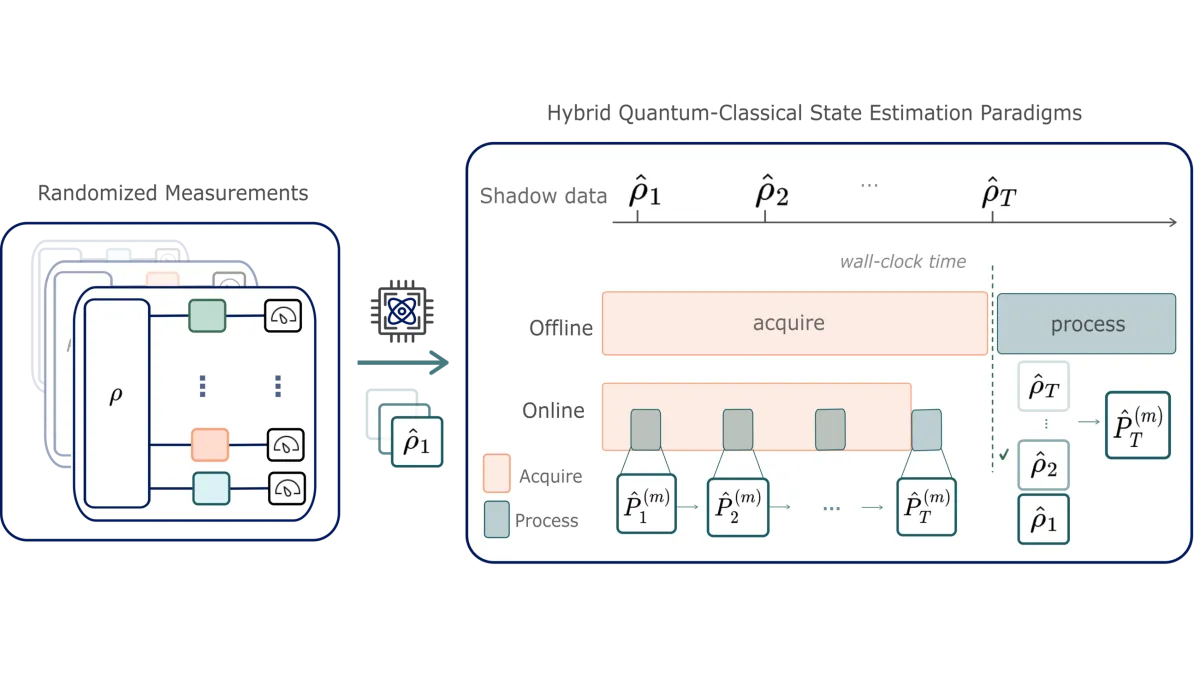
On the left, we can see a quantum state, where every qubit is randomly rotated and then measured in the computational basis. The measurement outcomes and chosen basis form a single snapshot of the system. To estimate properties, we repeat this workflow several times and forward the resulting tuples to the classical system.
For the classical system, we distinguish between two different types of post-processing.
- Offline: This is the workflow that is currently used for classical shadows applications. Classical post-processing starts only after the data acquisition has finished. As a result, the classical CPUs sit idle during data collection and are then, all of a sudden, tasked with processing many shots at once.
- Online (ours): Instead of waiting for data collection to finish, we directly post-process the data upon arrival of a new shot. This allows us to use CPU cores during data collection itself, which could significantly impact the wall-clock time.
We provide a proof-of-principle application for estimating higher-order PT moments, which is a method for verifying entanglement in quantum states.
The procedure is, however, by no means only applicable for this application. Rather, the problem description as an online estimator follows directly from the very formulation of classical shadows. It is a key aim of our work to stress that this online paradigm is indeed the most natural problem formulation.
Implications and Outlook
A key motivation for this work is to highlight that it is not only important to have efficient classical procedures, but that efficient system integration can significantly impact the wall-clock time. In particular, operations on quantum computers are known to be substantially slower than classical ones, and device overhead adds further costs.
For practical applications, it is thus important to view the hybrid system as a whole, and not only focus on one particular aspect of the pipeline. This perspective is closely related to ideas from distributed and heterogeneous systems. In particular, one could imagine batched or single measurements being directly forwarded to the classical computer, where jobs, corresponding to the different properties that one would like to estimate, are scheduled. These jobs can be dependent or independent of other preceding jobs, and they could even in turn spawn further jobs. The resulting formulation is an interesting problem in its own right, with significant overlaps with traditional computer science literature.
A preprint of this work is available as: Marso, M., Herbst, S., Wilkens, J., De Maio, V., Brandic, I. and Kueng, R. (2026). "An Online Approach for Entanglement Verification Using Classical Shadows". arXiv:2603.26602 [quant‑ph]. doi: 10.48550/arXiv.2603.26602.
Blog Image by Tung Lam from Pixabay.